|
 |
 |
 |
 |
 |
 |
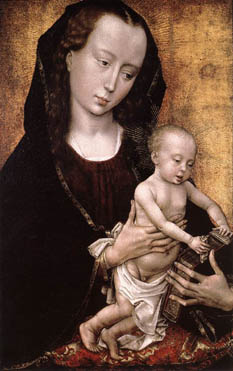
Diptyque de Philippe de Croy

 |
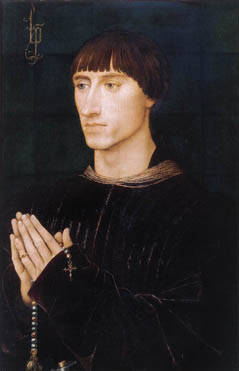 |
Rogier Van der Weyden, 1460s
huile sur bois, 49 x 31 cm
San Marin, Henry E. Huntington Library
huile sur bois, 49 x 30 cm
Anvers, Musée des beaux-arts

Cette Vierge à l'enfant est probablement l'aile gauche d'un diptyque dont l'aile droite, maintenant au Musée des beaux-arts d'Anvers, est un portrait de Philippe de Croy. Il subsiste néanmoins des doutes sur son attribution. Ce qui n'est pas le cas pour le portrait.
Rogier van der Weyden est nommé peintre officiel de la ville de Bruxelles en 1436. Son travail pour la ville consiste en des tableaux sur le thème de la justice pour la salle d'audience de la mairie. Outre son travail officiel, il fut chargé de faire un grand nombre de portraits, souvent par des mécènes distingués de la cour de Bourgogne : le duc Philippe le Bon, son fils, le duc Charles le Téméraire, Francesco d'Este, Nicolas Rolin, etc.
Philippe de Croy (1435-1511), "Le Grand Bâtard de Bourgogne", était un membre éminent de la noblesse bourguignonne. En 1457, il est chambellan de Philippe le Bon. Il a été administrateur du Hainaut en 1456-1465, et enfin, en 1473, il devient chevalier de l'Ordre de la Toison d'or.
Il est ici âgé d'environ 25 ans. Van der Weyden le dépeint comme un homme pieux et raffiné. Le fait qu'il soit représenté en prière soutient l'idée que ce portrait est bien la partie droite d'un diptyque.