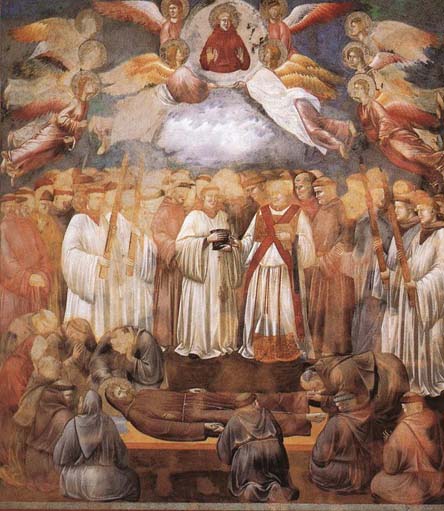
Giotto's authorship of some parts of the last scenes is often questioned, and in the case of those in the last bay (after No. 25, usually attributed to the St Cecilia Master) denied completely. The fact that a work was autograph mattered much less to the public of Giotto's day than it does to us, accustomed as we are to assigning importance (and therefore a price) only to works, preferable signed, by an individual artist. In those days the artist worked with a team of assistants, and not every work that left his studio was entirely autograph, even though it might have been signed by him. If the St Francis cycle at Assisi had borne a signature it would probably have been that of Giotto, despite the likelihood that his assistants played a key role in the execution. The final frescoes have a greater affinity with the overall cycle than with the works of other painters who have been suggested as Giotto's assistants. Even the last three scenes have very little real relation to the punctilious gothicism with which the St Cecilia Master expresses himself in the painting, now in the Uffizi, from which he takes his name, The have much more in common with the other frescoes of the St Francis cycle, a fact we can more readily acknowledge if we admit that some development was inevitable in the course of the execution of such a complex work. No one can deny the greatness of certain parts of the frescoes in the second bay of the left wall, such as the beautiful angels flanking those bearing the Saint's soul to paradise in the Death and Ascension of St Francis.