|
 |
 |
 |
 |
 |
 |
La sainte famille


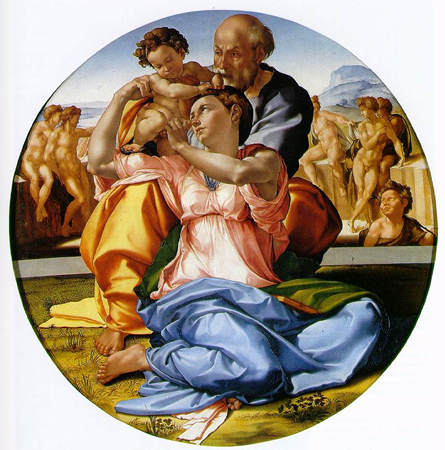
Michel-Ange, 1506
tempera sur bois, diamètre 120
Galerie des Offices, Florence

Michel-Ange a sans doute réalisé ce fameux tableau en 1506, à l'occasion de la naissance de la première fille d'Agnolo Doni et Maddalena Strozzi. Quelques années avant, Raphaël avait peint les portraits de Agnolo Doni et de son épouse dans un tableau aujourd'hui conservé à la galerie Palatine de Florence.
La Vierge, une jeune femme musculeuse, exécute un mouvement compliqué de torsion pour prendre l'Enfant que Joseph installe sur son épaule. Cette pose est très significative du style de l'artiste puisqu'elle permet une torsion des membres qui fait saillir les muscles du corps. Cet effet apparaît clairement dans les sculptures de Michel-Ange.
La luminosité des couleurs, les effets d'éclairage soulignent le caractére sacré des personnages.
Les nus à l'arrière-plan, dont les poses et les gestes sont tous imités des sculptures classiques, symbolisent l'humanité païenne, le monde d'avant la venue du Christ. Sur la droite, le petit saint Jean indique le passage, au travers du baptême, de l'âge païen à l'ère chrétienne.
C'est peut-être Michel-Ange lui-même qui a sculpté le cadre avec les armoiries des Strozzi (trois demi-lunes ainsi que la tête du Christ et les prophètes, sybils ou anges.
Le tableau a été restauré en 1985.