When, by the will of Pope Julius della Rovere (1503-13), Michelangelo went to Rome in 1505, the Pope commissioned him to build in the course of five years a tomb for the Pope. Forty life-sized statues were to surround the tomb which was to be 7 meter wide, 11 meter deep and 8 meter high; it was to be a free-standing tomb and to contain an oval funerary cell. Never, since classical times, had anything like this, in the West, been built for one man alone.
According to the iconographic plan, which we are able to reconstruct from written sources, this was to be an outline of the Christian world: the lower level was dedicated to man, the middle level to the prophets and saints, and the top level to the surpassing of both former levels in the Last Judgement. At the summit of the monument, there was to have been a portrayal of two angels leading the Pope out of his tomb on the day of the Last Judgement.
Michelangelo immediately began his preparations for this task, but the capricious Pope, in doubt of finding an appropriate place in which to erect his tomb, planned something even more grandiose: the restoration and remodelling of St Peter's. Thus Michelangelo was ordered to make other commissions, first in Bologna then in Rome, the ceiling of the Sistine Chapel.
After the death of the Pope in 1513 Michelangelo and the Pope's heirs reached a new agreement concerning the tomb. It was decided that the tomb was to be smaller and placed against a wall. After several further changes and simplifications the tomb was finally set up in San Pietro in Vincoli in Rome in 1545.
The slaves (four in Florence and two in Paris) were intended to the lower level, while the Moses for the middle level.
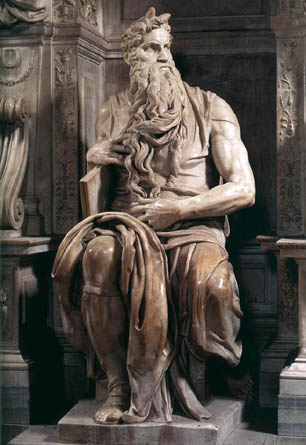
The statue of Moses is the summary of the entire monument, planned but never fully realized as the tomb of Julius II. It was intended for one of the six colossal figures that crowned the tomb. Elder brother to the Sistine Prophets, the Moses is also an image of Michelangelo's own aspirations, a figure in de Tolnay's words, "trembling with indignation, having mastered the explosion of his wrath".
The Moses was executed for Michelangelo's second project for
the tomb of Julius II. Inspired perhaps by the medieval conception of man
as microcosm, he brought together the elements in allegorical guise: the flowing
beard suggests water, the wildly twisting hair fire, the heavy drape earth.
In an ideal sense, the Moses represents also both the artist and the Pope,
two personalities who had in common what is known as "terribilità".
Conceived for the second tier of the tomb, the statue was meant to be seen
from below and not as it is displayed today at eye-level.